
CRED-NB is a co-host on the panel organized by the UNB RAVEN project. This is our final webinar for 2021. See the list of excellent speakers and register on the RAVEN website, HERE.
Author: CREDNB
The mining impact of electric vehicles
“Does the world need more electric vehicles? More Canada?” That’s the title of an interesting article in the NB Media Co-op today by Tracy Glynn, an assistant professor in the St. Thomas University Environment and Society program.
Glynn explains that the demand for electric vehicles is ramping up mining for the minerals required for vehicle batteries. Her message is that we need to be thinking about the social justice and wider implications of our energy choices.
Tracy Glynn’s article is HERE.
Physicist dismisses molten salt nuclear reactors as a “waste of time”
Nuclear expert M.V. Ramana at the University of British Columbia was interviewed recently in an Energy program on YouTube. In this interview, Ramana discusses the many problems inherent in molten salt reactors, such as the one proposed by Moltex for Point Lepreau and supported by both the provincial and federal government.
Watch the video HERE.
Commentary in Hill Times by CRED-NB core members
Gail Wylie (Council of Canadians Fredericton chapter) and Ann McAllister (Council of Canadians Saint John) published commentaries in the Hill Times this week.
Gail’s commentary challenged an earlier article in the Hill Times and underlined that the public interest requires reliable, affordable and truly clean energy, which does not include nuclear energy.
Ann’s letter urges the federal government to divert funds planned for nuclear development to renewable energy instead.
You can read their commentaries HERE.
New Brunswick is at the centre of a debate on nuclear weapons proliferation
Translation of an original French article by Michel Corriveau, Ici Nouveau-Brunswick, Radio Canada
October 27, 2021
There are about a dozen modular nuclear reactor projects in Canada. But Moltex’s project in New Brunswick will extract plutonium from nuclear waste, a radioactive metal that is also used to make weapons.
International and national experts are concerned about the possible consequences of Moltex’s modular reactor project. The fuel used by Moltex will be plutonium extracted from nuclear waste at the Point Lepreau nuclear power plant in New Brunswick. This radioactive metal can also be used to make bombs.
“I am very concerned that the Government of Canada has funded a Canadian company, Moltex, to develop a project that will challenge Canada’s policy on nuclear weapons proliferation,” said University of New Brunswick professor Susan O’Donnell.
O’Donnell, who worked for 13 years at the National Research Council of Canada as a technology adoption expert, questions New Brunswick’s role in the development of these technologies.
Experts fear that rogue nations or terrorist organizations could get their hands on the technology to extract plutonium, or on the plutonium itself.
A former U.S. White House national security adviser, Frank N. von Hippel, who is also a physicist and professor at the prestigious Princeton University in New Jersey, has been working on this issue for 45 years.
He believes that plutonium production is far too risky because of the potential for military use. Over the years, there have been many analyses that have shown that in fact it doesn’t make economic or environmental sense to separate plutonium for civilian purposes, and of course it doesn’t make sense to separate it for military purposes either,” he explains.
Nine American scientists have written two letters to the Canadian government. They denounce Ottawa’s $50.5 million support for Moltex Energy because they believe that if the project goes ahead, Canada would be breaking its policy of non-proliferation of nuclear weapons, and that could have important international consequences.
The controversy revolves around plutonium, a radioactive metal, which is produced during nuclear fission in a reactor like Point Lepreau. Plutonium can be extracted from nuclear waste through pyro-processing, a technology that Moltex intends to use.
The cause for concern: a bomb in India
As early as 1956, Canada gave a research reactor called CIRUS to India. India subsequently purchased two power reactors from Canada, in 1963 and 1966. India used the plutonium extracted from the nuclear waste of the research reactor to secretly build an atomic bomb.
To everyone’s surprise, in 1974, India exploded its first atomic bomb in the Rajasthan desert. South Korea, Pakistan, Taiwan and Argentina, which had purchased Canadian reactors, were trying to do the same.
These events led the United States and Britain, with Canadian participation, to establish the London Club, which became the Nuclear Suppliers Group, to better control the proliferation of nuclear weapons.
Given the risk of proliferation, in 1977 U.S. President Jimmy Carter called for the end of funding for a US reactor project that would have used plutonium as fuel. “I originally became involved as a scientific advisor under US President Jimmy Carter, and the Carter administration decided that in fact plutonium separation did not make sense for the United States. We stopped it; and we appealed to other countries to do the same,” recalls former advisor Frank N. von Hippel.
Congress ended funding for the plutonium extraction project in 1983. To this day, the issue has been the subject of much tug-of-war in the United States, where the research has continued. “Some of us have sent a similar letter [to the one sent to Ottawa] to the Biden administration and the Department of Energy, which is currently promoting similar programs,” says Frank N. von Hippel.
Civilian plutonium and nuclear weapons
Plutonium for military purposes, to make bombs, is not produced in the same manner as plutonium for civilian purposes (to generate electricity, for example). And military plutonium is of a different composition than civilian plutonium.
However, while so-called civilian plutonium is not ideal for military use, it can still be used to make nuclear bombs. Nevertheless, the nuclear industry and independent scientists do not agree on this aspect.
A group of power generation and distribution companies, including NB Power, is supporting several modular nuclear reactor projects, including the Moltex project in New Brunswick.
The group claims that its plutonium-based fuel extraction methods are more proliferation-resistant than processes used more widely around the world, as stated in Feasibility of Small Modular Reactors, an April 2021 report by Ontario Power Generation (OPG), Bruce Power, NB Power and SaskPower. However, the report does not demonstrate how this would be the case. Only one sentence in the entire document touches on this important issue.
Moltex asserts that the plutonium it intends to produce could not be used for military purposes, because the plutonium produced in Saint John, New Brunswick, would not be pure. The main result of the WATSS process [Moltex’s pyro-processing technology] is an impure extraction, a mixture of minor actinides [including plutonium],” the company stated in a written reply.
But this argument has already been rejected by experts on more than one occasion.
In 2009, a team of experts from major U.S. national laboratories concluded that even non-pure plutonium [from pyro-processing] can be used to make nuclear weapons.
According to these experts, it would only take a few days or weeks for this plutonium to be used for military purposes. The plutonium would be much more accessible after it has been separated from the main radioactivity in the spent fuel; it would be easy to separate the plutonium even in a glove box. “You wouldn’t need a reprocessing plant – and many studies have come to this conclusion,” argues Frank N. von Hippel.
Plutonium under close surveillance
The risk with plutonium and the technology for its extraction is that it may fall into the hands of militaristic regimes or terrorist groups. For this reason, countries with plutonium stocks keep them under close surveillance. “The plutonium that has been produced in France, England and Japan is very heavily guarded; it’s in very, very secure facilities, and it’s under – let’s call it military-grade security”, says Professor Susan O’Donnell.
The question of security around possible Canadian production is therefore raised, but there is more. Moltex wants to sell its technology – if it can develop it – to other countries. “What is the plan to verify or validate the security situation in the countries they propose to export to?” asks O’Donnell.
Only a handful of countries such as France, England, Russia and Japan have plutonium for civilian use. My colleagues and I have been trying to persuade these countries to stop separating plutonium; it is possible that Japan … will change its policy and decide that it doesn’t make sense,” says Frank N. von Hippel.
Except that South Korea uses the example of Japan to justify its willingness to begin plutonium production. If Canada were to produce plutonium as well, it would give even more weight to South Korea’s claims,” said the former White House adviser. Frank N. von Hippel is concerned that South Korea may ultimately want to acquire nuclear weapons.
We’ve had this discussion with South Korea, for example, where more than half the population thinks that if South Korea gets a nuclear weapon, it’s a deterrent against North Korea,” he says.
A report by the International Atomic Energy Agency in August 2021 said North Korea had resumed producing plutonium for military purposes and had significantly expanded its nuclear arsenal over the past 20 years.
The government is silent on the issue
Both the Liberal Party of Canada and the Conservative Party of Canada support the development of modular nuclear reactor projects, including the Moltex project, which involves the extraction of plutonium from nuclear waste. However, neither party responded to our requests for interviews on this issue during the last election campaign.
We were also unable to obtain an interview with the federal government to answer the many questions raised by the independent scientists.
A media relations manager at the federal Department of Natural Resources provided a brief e-mail message stating that the Government of Canada is reviewing the science and technology of reprocessing, as well as the benefits and risks associated with this activity, in order to guide any future policy on this issue.
On the question of the use of plutonium for military purposes, she added that nuclear technology in Canada is – and will continue to be – used for peaceful purposes only.
None of the independent scientists who have raised concerns question this. The risk, they say, is not that Canada will engage in nuclear weapons production; rather, it is the use that other countries or organizations might make of this technology and the message that Canada sends to the international community.
New Brunswick’s Minister of Natural Resources and Energy Development, Mike Holland, was the only politician who agreed to answer our questions about the proliferation risk.
According to Mike Holland, experience elsewhere in the world has shown that pyro-processing cannot be used to make weapons-grade plutonium; a view not shared by all scientists.
Why New Brunswick?
The Moltex project is being developed in New Brunswick for several reasons. First and foremost, there is Point Lepreau, since Moltex will need the waste from this nuclear plant.
There is also a clear political will to move forward with this type of technology. The provincial government has invested several million dollars to allow two companies to continue their development in the province.
Finally, the industry believes that the New Brunswick population is quite supportive of nuclear power. New Brunswick is an attractive place to be because it has a population that generally supports nuclear power,” says the Feasibility of Small Modular Reactor report.
Except that little information has leaked out about the exact nature of the Moltex project, in particular, and the possible consequences.
Many, including Frank N. von Hippel and Susan O’Donnell, are calling on the government to conduct an independent assessment of the Moltex project.
The New Brunswick government has no intention of asking for an independent study. It’s a low-grade plutonium product, and of course I’m not a scientist…but I take the information that comes from the regulators,” said Holland, referring to the federal Canadian Nuclear Safety Commission.
For its part, the Canadian government has not responded to this request from the scientists, and in the terse response we received from the communications department, there is no mention of any independent study.
13 New Brunswick groups ask PM Trudeau for a moratorium on new nuclear
More than 70 groups, including 13 in New Brunswick, sent a letter to Prime Minister Trudeau asking for a moratorium on new nuclear energy to be included in the mandate letters of the new cabinet, expected to be named next week.
October 4, 2021
The Right Honourable Justin Trudeau
Prime Minister of Canada
80 Wellington St.
Ottawa, ON K1A 0A2
by email: justin.trudeau@parl.gc.ca
A moratorium on federal funding for nuclear expansion: mandate letters to cabinet
Dear Prime Minister:
Congratulations on your recent re-election. As organizations working tirelessly to protect the environment and seek solutions to the critical issue of climate change, we reflect the concerns of millions of Canadians and work as allies with Indigenous nations.
We request your attention to a critical matter of human health, environmental and intergenerational importance. In your action on climate change, we ask your government to refrain from supporting nuclear infrastructure expansion, including so-called small modular nuclear reactors (SMRs); support would delay addressing climate change because speculative SMR technology would be ready too late and pose safety and security risks. We strongly recommend that your office consult the latest expert analysis conducted by independent researchers, available in the 2021 World Nuclear Industry Status Report.
We are aware that your government is dedicating $8 billion to a “Net Zero Accelerator” fund in addition to other funding envelopes which could be available to develop new nuclear reactor prototypes. SMRs should not be eligible for any government funding, and certainly not as part of a climate action plan.
During the previous term, your government undertook no consultation whatsoever with environmental and citizen groups about new nuclear development. Further, funding or plans for new nuclear development were not included in the 2021 election platform of the Liberal Party. Your government does not have a mandate from Canadians to spend public funds on new prototype nuclear reactors, especially considering the danger and risks of the wastes generated and nuclear weapons proliferation.
The public’s voice cannot be ignored. In 2018, the Assembly of First Nations issued resolution 62/2018 calling for the Government of Canada to cease funding and support of the Small Modular Nuclear Reactors program. This past year, 120 civil society, public interest and Indigenous groups signed a public statement sent to you and all Members of Parliament; this statement expressed their opposition to federal funding for SMRs, explaining why the proposed new nuclear reactors are “dirty, dangerous distractions” from genuine climate action.
As your government deliberates on its priorities, in the mandate letters of the ministers responsible for Health Canada; Environment and Climate Change Canada; Global Affairs Canada; Natural Resources Canada; Innovation, Science and Economic Development Canada and the regional development agencies; and Transport Canada, we urge you to include a specific direction to:
- Institute a moratorium on funding for new prototype nuclear reactors, for uranium enrichment plants and for used-fuel reprocessing installations, until long term safe monitored containment from the biosphere can be implemented for intermediate and high-level radioactive wastes.
- Strengthen the independence, transparency and accountability of the Canadian Nuclear Safety Commission and ensure all SMRs are subject to full impact assessments (now, appallingly, most proposed SMRs are exempt from federal impact assessment).
- Ensure that the government and the nuclear industry engage in free, prior, and informed consent with Indigenous peoples on all nuclear development, including modular nuclear reactors, uranium mines and radioactive waste facilities.
- End the expansion of Class 1 nuclear facilities in residential areas; the unsuccessful $1 billion attempt to clean up Port Hope, in Ontario, indicates the financial and health risks associated with locating nuclear facilities in proximity to housing and schools.
- Institute a high-level review, including by international experts, of both the nuclear weapons proliferation and environmental implications of the federally funded plutonium-extraction project currently underway at Chalk River, in Ontario, and planned for development on the Bay of Fundy in New Brunswick.
- Ban the import of nuclear waste and nuclear material, i.e., plutonium from dismantled nuclear warheads.
In addition, we demand that you make public the expected cost of your government’s plan to develop new nuclear reactor prototypes including the cost of long-term management of their radioactive wastes.
We request your response as soon as possible using the following email address: info@crednb.ca
Sincerely,
Groups undersigned:
Action Climat Outaouais (QC) Réal Lalande, président
Action Environnement Basses-Laurentides (QC) Lucie Massé, porte-parole
Algonquin Eco Watch (ON) Mike Wilton, President
Anishinabek Nation (ON) Mel Hardy, Regional Deputy Grand Council Chief
Artiste pour la paix (QC) Pierre Jasmin, Leader
Association québécoise de lutte contre la pollution atmosphérique (QC) André Bélisle, président
Bonnechere River Watershed Project (ON) Dr. Kathryn Lindsay, Chair/Program Volunteer
Canadian Environmental Law Association (ON) Theresa McClenaghan, Executive Director and Legal Counsel
CARN – Citizens Against Radioactive Neighbourhoods (ON) Jane Scott, founding member
Citizens Resistance At Fermi Two (CRAFT) (Michigan) Jesse Deer In Water, Community Organizer
Citoyens au Courant de Vaudreuil-Soulanges (QC) Katherine Massam, porte-parole
ClimateFast (ON) Lyn Adamson, Co-Chair
Coalition for a Clean Green Saskatchewan (SK) David Geary, researcher
Coalition for a Nuclear Free Great Lakes (Michigan) Michael J. Keegan, representative
Coalition for Responsible Energy Development (NB) Ann McAllister, David Kersey, Lise Auffray, members
Concerned Citizens of Manitoba (MB) Anne Lindsey, representative
Concerned Citizens of Renfrew County and Area (ON) Ole Hendrickson, PhD, Researcher
Conservation Council of New Brunswick (NB) Louise Comeau, PhD, Director of the climate change and energy program
Council of Canadians (ON) Mark Calzavara, National Water Campaigner
Council of Canadians – Fredericton Chapter (NB) Gail Wylie, representative
Council of Canadians – Kitchener-Waterloo (ON) Marilyn Hay, Chair
Council of Canadians – Ottawa Chapter (ON) Eva Schacherl, Volunteer
Council of Canadians – Saint John Chapter (NB) Leticia Adair, Contact
Eau Secours (QC) Rébecca Pétrin, directrice générale
Église Unie Westmount Park (QC) Rév. Neil Whitehouse, président du Conseil d’administration
EOS Eco-Energy (NB) Amanda Marlin, Executive Director
Équiterre (QC) Émile Boisseau-Bouvier, Analyste, politiques climatiques et transition écologique
Extinction Rebellion New Brunswick (NB) Doug Swain, PhD, Organiser
Friends of the Earth Canada (ON) Beatrice Olivastri, CEO
GMob (GroupMobiliation) (QC) Michel Jetté, co-fondateur
Green Coalition/Coalition Verte (QC) Gareth Richardson, President
Greenspace Alliance of Canada’s Capital (ON) J. P. Unger, Director
Inter-Church Uranium Committee Educational Cooperative (SK) Michael Poellet, President
International Physicians for the Prevention of Nuclear War Canada (BC) Jonathan Down, President
MiningWatch Canada (ON) Jamie Kneen, Co-manager
Mouvement Vert Mauricie (QC) Patrick Rasmussen, président
National Council of Women of Canada (ON) Patricia Leson, President
NB, not Nuclear – Le NB, non le nucléaire (NB) Erik LeBrun, Founder/Administrator
New Brunswick Anti Shale Gas Alliance (NB) Roy Ries, Coordinator and Jim Emberger, Spokesperson
Northwatch (ON) Brennain Lloyd, Project Coordinator
Old Fort William Cottagers’ Association (QC) Johanna Echlin, M.Ed, Spokesperson
Ontario Clean Air Alliance (ON) Angela Bischoff, Director
PEI (Epekwitk) Fridays for Future Climate Action Group (PE) Tony Reddin, co-coordinator
Peterborough Pollinators (ON) Jo Hayward-Haines, co -founder
Pontiac Environment Protection (QC) Deborah Powell, President
Port Hope Community Health Concerns Committee (ON) Faye More, Chair
Prairie Institute for Human Ecology (SK) Lynn Wesley Oliphant, Coordinator
Prevent Cancer Now (ON) Meg Sears, PhD, Chair
Project Ploughshares Saskatoon (SK) Linda Murphy, secretary/treasurer
QuAppelle Valley Environmental Association (SK) Randall Lebell, Communications
Ralliement contre la pollution radioactive (QC) Ginette Charbonneau et Gilles Provost, porte-paroles
RAVEN project at the University of New Brunswick ( NB) Susan O’Donnell, PhD, Leader
Regroupement des citoyens de Saraguay (QC) Sylvia Oljemark, présidente
Regroupement écocitoyen de Sainte-Marthe-sur-le-Lac (QC) Sylvie Rose Clermont, présidente
Regroupement vigilance hydrocarbures Québec (QC) Philippe Duhamel, coordonnateur général
Religieuses de Notre-Dame-du-Sacré-Coeur (NB) Ida Nolan, Murielle Duguay, Thérèse Belliveau, Membres de la Communauté
Réseau québécois des groupes écologistes (QC) Chantal Levert, coordonnatrice générale
San Luis Obispo Mothers for Peace (California) Jane Swanson, President
Saskatoon Peace Coalition (SK) Michael Murphy, Chairperson
Sierra Club Canada Foundation (ON) Gretchen Fitzgerald, National Programs Director
Sierra Club Québec (QC) Isabelle Sawyer, co-présidente
Solar Island Electric Inc. (PE) Darcie Lanthier, President
St. Stephen Environmental Group (NB) Chris Corey, Director
STOP THE HOGS (SK) Elaine Hughes, Administration
Sustainable Development Association & Indigene Community (QC) Douglas Jack, President
Sustainable Energy Group (NB) Sam Arnold, Co-ordinator
Unifor Québec (QC) Raymond Thibert, président Comité de santé, sécurité et environnement d’Unifor
United Church of Canada (NB) Kent Gibbons, Minister
VANA (Veterans Against Nuclear Arms) Saskatoon (SK) Colin Clay, Member
WaterCareAllies (First United Church, Westboro) (ON) Judith Miller, Coordinator
Women’s Healthy Environments Network (ON) Cassie Barker, Executive Director
Global 2021 nuclear report launch and distinguished speakers
Tuesday, Sept. 28, 11am to 1pm Atlantic
We’re pleased to announce that CRED-NB member RAVEN at the University of New Brunswick, and the Environment & Society Program at St. Thomas University are the Canadian co-hosts of the global launch of the World Nuclear Industry Status Report! The WNISR is an independent expert assessment of nuclear industry developments globally.
For more information and the join link, go to the info on the RAVEN website:
https://raven-research.org/global-launch-of-the-world-nuclear-industry-status-report-2021/
Federal parties and candidates on nuclear: for the record
What are the federal party positions on funding for new nuclear reactors? Read an article published this week in the Hill Times and the NB Media Co-op:
Party election platforms: Should new nuclear reactors be part of Canada’s climate action plan?
https://nbmediacoop.org/2021/09/17/party-election-platforms-should-new-nuclear-reactors-be-part-of-canadas-climate-action-plan/
The story was written by CRED-NB member Susan O’Donnell and Gordon Edwards, President of the Coalition for Responsible Energy Development in New Brunswick.
CRED-NB sent a questionnaire with four questions about nuclear issues to candidates in all federal ridings in New Brunswick. Only seven candidates responded. Click here to see the full questions. Here’s a summary of the questions and responses:
Q1: Question about nuclear energy and the climate crisis:
Given the urgency of the climate crisis and the need for proven technologies ready to deploy now, do you support a moratorium on federal public funding for speculative nuclear reactors, including those described as “small modular reactors”?
6 candidates said YES:
- 3 NDP candidates: Evelyn Godfrey (Beausejour) • Richard Trevor Warren (New Brunswick Southwest) • Don Paulin (Saint John – Rothesay)
- 2 Green candidates: Richard Dunn (Moncton – Riverview – Dieppe) • Ann McAllister (Saint John – Rothesay)
- 1 Libertarian candidate: Brendon Kirby (Fredericton)
One candidate said NO:
- Green candidate: John Reist (New Brunswick Southwest)
___________________________________________
Q2: Question about nuclear waste
Do you support the Wolastoq Grand Council resolution opposing nuclear energy and nuclear waste on traditional Wolastoq territory?
6 candidates said YES
- 3 NDP candidates: Evelyn Godfrey (Beausejour) • Richard Trevor Warren (New Brunswick Southwest) • Don Paulin (Saint John – Rothesay)
- 3 Green candidates: Richard Dunn (Moncton – Riverview – Dieppe) • John Reist (New Brunswick Southwest) • Ann McAllister (Saint John – Rothesay)
One candidate said NO
- Libertarian candidate: Brendan Kirby (Fredericton)
____________________________________________
Q3: Question about informed consent with Indigenous peoples on new nuclear development
Do you support free, prior, and informed consent with Indigenous peoples on new nuclear development, including modular nuclear reactors. uranium mines and radioactive waste facilities?
All 7 candidates said YES
- 3 NDP candidates: Evelyn Godfrey (Beausejour) • Richard Trevor Warren (New Brunswick Southwest) • Don Paulin (Saint John – Rothesay)
- 3 Green candidates: Richard Dunn (Moncton – Riverview – Dieppe) • John Reist (New Brunswick Southwest) • Ann McAllister (Saint John – Rothesay)
- Libertarian candidate: Brendan Kirby (Fredericton)
____________________________________________
Q4. Question about nuclear weapons
Do you support the call for a high-level review, including by international experts, of both the nuclear weapons proliferation and environmental implications of New Brunswick’s plutonium-extraction project?
5 candidates said YES
- 3 NDP candidates: Evelyn Godfrey (Beausejour) • Richard Trevor Warren (New Brunswick Southwest) • Don Paulin (Saint John – Rothesay)
- 2 Green candidates: Richard Dunn (Moncton – Riverview – Dieppe) • Ann McAllister (Saint John – Rothesay)
One candidate said NO
- Green candidate: John Reist (New Brunswick Southwest)
One candidate was undecided
- Libertarian candidate: Brendan Kirby (Fredericton)
Rally Sept. 24 – Climate Emergency: This is Not a Drill
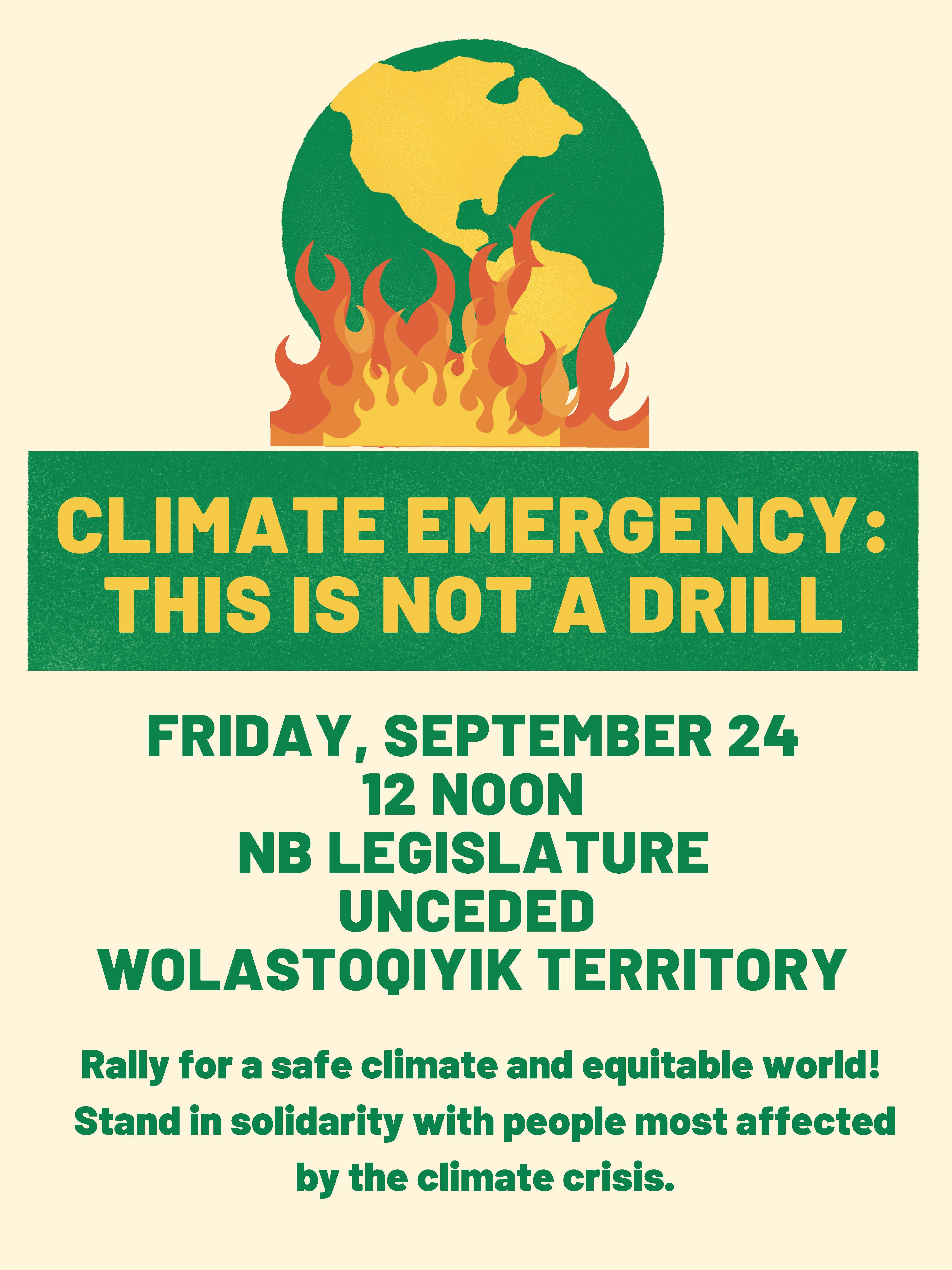
Rally for a safe climate and equitable world! Stand in solidarity with people most affected by the climate crisis.
Friday, September 24 @noon at the New Brunswick Legislature in Fredericton.
Optional: 10:30am meet at Conserver House, 180 St. John Street (near the Legislature) to make signs.
Hear from climate activists, Indigenous land defenders, youth, scientists, trade unionists, energy policy experts and elected representatives on what a just energy transition looks like for Fredericton, New Brunswick, Canada and beyond.
“Not a drill”: Fredericton rally to call for climate justice
Extinction Rebellion New Brunswick and partner organizations, including environmental groups and labour unions, invite everyone to assemble at the New Brunswick Legislature in Fredericton on unceded Wolastoqiyik territory on September 24 at noon to demand that all levels of government take immediate and effective action on the climate emergency that respects climate justice.
Participants are asked to wear masks and stand six feet apart in a visual display of safety and solidarity with everyone around the world affected by climate change and the global pandemic.
“Our Indigenous Elders have told us for decades that humans have lost their way by neglecting to uphold the original teachings on how to respect and live in balance with Mother Earth. Hence, we are presently in a state of emergency facing global climate disasters and it will only worsen if we as humans don’t stop the greed of corporations and colonial governments,” says Wolastoqewi Grand Chief spasaqsit possesom – Ron Tremblay.
“Climate justice goes beyond advocating for renewable energy, recognizing that injustice is linked to social, economic, and political systems and that climate change has its roots in capitalism, colonialism, the patriarchy and other systems of oppression,” says Susan O’Donnell, one of the climate rally organizers and lead researcher with the RAVEN project at the University of New Brunswick.
With New Brunswick refusing to close the Belledune coal plant in 2030 as part of Canada’s transition off coal, advocates for a just energy transition point to the need to include all affected workers and communities in climate solutions and future economic planning.
“Now is the time to be talking about a just energy transition for workers in the fossil fuel and nuclear sectors and their communities in New Brunswick as well as in Colombia where NB Power has been sourcing coal from the Cerrejón coal mine since the 1990s. It’s not the time to keep yesterday’s fuel sources like coal and nuclear on the table,” said Tracy Glynn, one of the rally organizers and who has worked with Colombian coal miners and affected community members to tell their stories for more than a decade.
“The coal burned in Belledune comes from Colombia where its extraction is linked to the forced displacement and starvation of Indigenous Wayuu and Afro-Colombian farmers and children and repression of coal miners and unionists. Climate justice is migrant justice. It’s reproductive justice. It’s housing justice,” says Glynn.
Climate activists, Indigenous land defenders, youth, scientists, trade unionists, energy policy experts, and elected representatives will share their thoughts on what a just energy transition looks like for Fredericton, New Brunswick, Canada and beyond. Ron Tremblay, the Wolastoq Grand Chief, David Coon, MLA for Fredericton South, Fredericton Mayor Kate Rogers, Lois Corbett, Executive Director of the Conservation Council of New Brunswick, and Danny Legere, President of the New Brunswick Federation of Labour are among the speakers.
This rally is supported by Extinction Rebellion New Brunswick, Council of Canadians Fredericton Chapter, Council of Canadians Saint John Chapter, Coalition for Responsible Energy Development in New Brunswick (CRED-NB), Conservation Council of New Brunswick, CUPE NB, Fredericton Club of the Communist Party of Canada, Leap4wards Saint John, New Brunswick Anti-Shale Gas Alliance (NBASGA), New Brunswick Federation of Labour, NB Media Co-op, No One Is Illegal Fredericton, RAVEN, Reproductive Justice NB and Solidarité Fredericton.
All social justice, environmental and climate action groups are invited to endorse this rally. To add your name to our event coalition, contact: fredericton.solidarity@gmail.com.
For more information, contact Tracy Glynn, 506 440-5592, fredericton.solidarity@gmail.com.
XRNB: Work together on the climate emergency NOW plus invite to meeting
1 September 2021
Work together to force governments to act on the climate emergency NOW!
Hello everyone,
My name is Doug Swain. I’ve been a member of Extinction Rebellion New Brunswick (XRNB) since April 2019. I’m writing to you because we are at a critical stage in the climate crisis. The 2018 IPCC report stated that we needed to reduce Greenhouse Gas (GHG) emissions by about 50% globally by 2030 to avoid a high probability of unstoppable runaway climate change. Three years out of the 12-year window have already passed and GHG emissions continue to rise in Canada.
Now the latest report concludes that the 2018 report was too optimistic, and greater and sooner reductions in GHG emissions are now needed (XR would say that we need net-zero by 2025). But Canada hasn’t even started to address the 2018 target of ~50% reductions by 2030.
Scientists have warned about global warming for over 30 years but governments have failed to act. Now they must take strong action immediately. In my view, governments will only start to address the climate emergency with the required urgency if 10s of 1000s of people are marching repeatedly in the streets across the country. I don’t think that this will happen until the many climate action, environmental and just transition groups act together to mobilise these numbers. So I am writing to you to see whether your group would consider working together with like-minded groups to make this happen. I have set up a Zoom meeting on September 15 for us to discuss this. The link and details are below.
Also, if you want to give this a try before our meeting, there will be an opprtunity on Wednesday Sep 8 in Saint John. On Sep 8, 350.org is organizing marches or rallies across Canada to demand a moratorium on fossil fuel expansion, including stopping existing expansion projects, and an urgent and robust just transition plan that leaves no one behind and moves us past fossil fuels. For further details and sign-up google ‘350.org/still-on-fire/’
Thanks you for your consideration.
Sincerely,
Doug Swain
Extinction Rebellion New Brunswick.
***
Invitation to work together in the fight for action on the climate emergency
Topic: WorkTogether
Time: Sep 15, 2021 07:00 PM AST
Join Zoom Meeting
https://us02web.zoom.us/j/88954463889?pwd=aUEwelJxekZPTlpKemhnV2dSbkFxQT0
9
Meeting ID: 889 5446 3889
Passcode: 276441
One tap mobile
+16473744685,,88954463889#,,,,276441# Canada +16475580588,,88954463889#,,,,276441# Canada
Dial by your location
+1 647 374 4685 Canada
Meeting ID: 889 5446 3889
Passcode: 276441