
RAVEN and CRED-NB member Susan O’Donnell published an analysis of the $20 million gift announced last week by the New Brunswick premier. Read her commentary in the NB Media Co-op here.
Author: CREDNB
Nuclear energy is dirty. It should never be funded by governments.

In February, the New Brunswick government announced another gift to the nuclear industry: $20 million to continue designing a prototype nuclear reactor that, if built, will create new and even more toxic kinds of nuclear poisons. Read our fact sheet: Nuclear is dirty energy.
100 groups ask: What will we do with our nuclear waste?
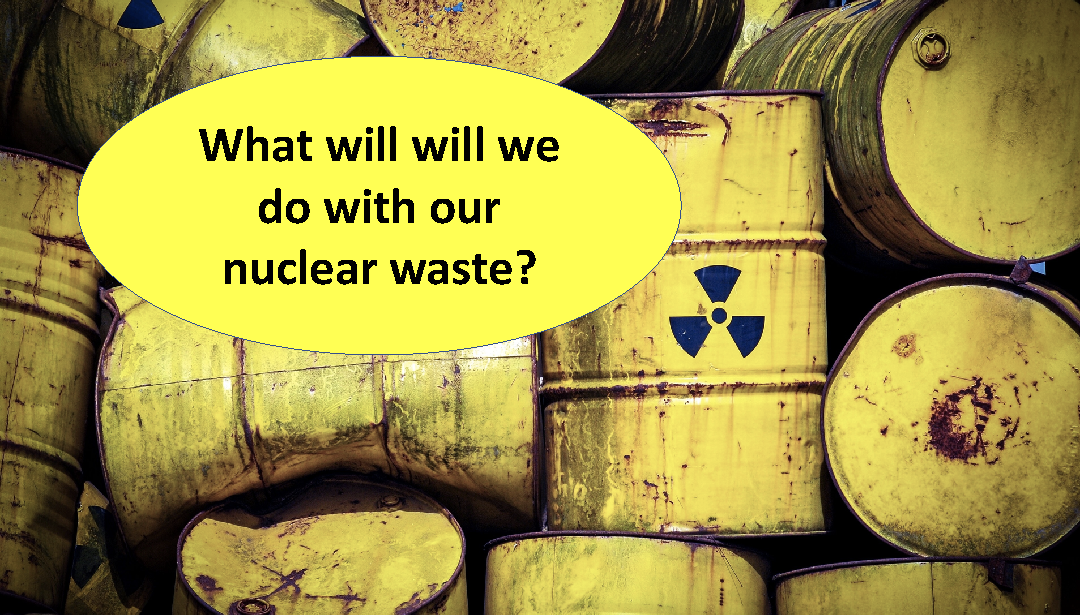
Ottawa – Over 100 public interest and community groups signed on to a joint letter setting out their expectations for a review of Canada’s Radioactive Waste Policy launched by Natural Resources Canada last November. Top on their list: the review must be transparent, and independent of the nuclear industry.
In previous communications, the groups have strenuously objected to the decision by Natural Resources Canada to delegate the development of strategies for the management of radioactive waste to an industry organization, the Nuclear Waste Management Organization (NWMO). The NWMO was formed by the power companies who own nuclear reactors in 2002 to develop a plan to manage high level nuclear fuel waste.
The letter states:
As public interest groups, many with considerable expertise in nuclear waste management, we consider this Review to be of utmost national importance. The outcomes of the Review process will impact not only the current generation of Canadians but also generations to come. As we have communicated with NRCan staff and in earlier letters to you as Prime Minister of Canada and as Minister of Natural Resources, we have serious concerns about the shape of the review as announced to date.
In particular, a timeline with March 31, 2021 for the end of public engagement is unreasonable and unacceptable. Most Canadians have not yet even been made aware of this review and its far-ranging implications. At the very least, Canadians must be given notice of the Review process and opportunities to participate.
To date, NRCan has populated a web site, posted four discussion papers and comment forums, and held one by-invitation “information session” and a number of bilateral conversations with civil society organizations and others in December 2020. The format and frequency of the Departments interaction with the nuclear industry and nuclear supply companies is unknown.
The letter with the 100+ endorsing groups can be viewed at www.nuclearwastewatch.ca.
CRED-NB pre-budget submission to the New Brunswick government
Today we sent to the New Brunswick government and the opposition parties our submission to the pre-budget consultations. In the throne speech last year, the government missed the opportunity to announce a bold plan for renewable energy and energy-saving retrofits. Instead, the speech mentioned the new nuclear reactors proposed for the province.
Our submission analyses what we should see in the budget for responsible energy development in New Brunswick. Read it here.
Webinar Feb. 23: Transitioning to a Low-Carbon Economy in New Brunswick
Chris Rouse: Transitioning to a Low-Carbon Economy in New Brunswick: Why public investments are better than incentives
Free event, everyone welcome. Tuesday, Feb. 23 at 7pm.
Register to receive the event link and a reminder:
https://unbvirtualclasses.zoom.us/meeting/register/tJwpdeGqqTsuE9S63pfdy_GVFzxQjEyypL7q
Chris Rouse is the founder of New Clear Free Solutions and has been very active in the environmental movement for over 10 years. Chris has a very extensive technical background. He has developed an Integrated Resource Plan for New Brunswick that achieves a 95% Renewable energy solution through public investments. The IRP offers the least cost sustainable solution to our environmental problems that benefits all New Brunswicker both now and in the future.
This event is organized by the Coalition for Responsible Energy Development in New Brunswick (CRED-NB), Extinction Rebellion New Brunswick, and the RAVEN project (Rural Action and Voices for the Environment) at the University of New Brunswick.
What are the links between nuclear reactors and nuclear weapons? (video)
CRED-NB hosted an international webinar to explore this question, five days after the Treaty on the Prohibition of Nuclear Weapons came into force. The panelists: Ray Acheson, Zia Mian, David Lowry and Gordon Edwards. Co-hosts were the Canadian Environmental Law Association, Beyond Nuclear and the NB Media Co-op. Watch the video here.
Groups object to nuclear regulator’s plan to weaken rules for experimental nuclear reactors
OTTAWA, January 21, 2021 – Civil society groups are objecting to plans by the Canadian Nuclear Safety Commission (CNSC) to weaken its nuclear security regulations. A staff presentation to the Commission today reveals that they have been reviewing the regulations since 2018, with no public consultation.
The presentation says amendments are underway to “remove prescriptive requirements” from the Nuclear Security Regulations and publish the revised regulations by late 2021 or early 2022.
A paper by Natural Resources Canada says that prescriptive regulations are more detailed and stringent, and easier to monitor and enforce.
“While the CNSC asserts its decision making is ‘free from external pressure,’ civil society groups continue to question the regulator’s independence,” said Kerrie Blaise of the Canadian Environmental Law Association. “The CNSC is supporting the nuclear industry’s requests to remove regulatory barriers for Small Modular Reactors (SMRs).”
Indeed, the federal government’s recent SMR action plan confirms that one of its expected results is that “Revised Nuclear Security Regulations only cover high-level principles similar to other regulations and prescriptive requirements are removed.”
The CNSC presentation shows that Canada’s nuclear regulator intends to change its regulatory approach to accommodate new experimental reactor technologies, known as small modular reactors (SMRs). Other regulations being “enhanced” by CNSC deal with safety assessment, design and licensing of nuclear power plants.
Today’s CNSC meeting will finish with an in-camera closed session to consider a staff presentation entitled, “Regulatory project to amend the General Nuclear Safety and Control Regulations and the Nuclear Non-proliferation Import & Export Control Regulations.”
“We are disappointed that CNSC staff has forged ahead and is now proposing a looser regulatory approach without any consultation with Canadians who would be directly affected if and when one of these new experimental reactors is trucked into their community,” said Brennain Lloyd, coordinator of Northwatch, based in northeastern Ontario.
The plan to expand new nuclear technologies across Canada and into remote mining and Indigenous communities is controversial. The United Church of Canada recently joined with over 100 citizen groups, the Assembly of First Nations, the Chiefs of Ontario, the Anishinabek Nation, and three federal parties in opposing SMRs.
The federal government has been promoting SMRs with its action plan and funding from Innovation, Science and Economic Development Canada (ISED)’s Strategic Innovation Fund, saying that “Canada is poised to be a leader in the safe and responsible development” of SMRs. Yet the government has exempted most SMRs from a federal environmental assessment under the new Impact Assessment Act.
Critics say that SMRs would require billions in public subsidies and fear that their designers also want more relaxed safety and security regulations. Of the more than 50 designs that exist for experimental nuclear reactors, the CNSC is reviewing a dozen under pre-licensing agreements with companies like Moltex Energy and GE-Hitachi.
“The CNSC’s SMR design reviews are taking place behind closed doors,” said Lloyd. “That allows these private sector companies to sell their unproven reactor designs to the regulatory staff without any public scrutiny.”
The CNSC staff presentation also states that CNSC is “supporting” two SMR vendors active in New Brunswick, including the study of how they might extract plutonium from highly radioactive irradiated CANDU fuel. A government report highlighted that reprocessing used CANDU fuel, which has never been done previously in Canada, raises nuclear weapons proliferation risks.
“We are outraged that New Brunswick is being used for a risky and costly experiment with dangerous radioactive materials, and that we will not have an opportunity to voice our concerns during a federal Impact Assessment,” said Dr. Susan O’Donnell, spokesperson for the Coalition for Responsible Energy Development in New Brunswick.
The CNSC staff presentation suggests that the first SMRs are expected to be constructed soon. Global First Power applied in early 2019 for a license to prepare a site at Chalk River, Ontario (on federally owned land), and Ontario Power Generation has notified the CNSC of its intent to apply for a license to construct new reactors at the Darlington Power Plant by March 2022.
– 30 –
Media contacts:
Kerrie Blaise
Northern Legal Counsel, CELA
Email: kerrie@cela.ca
Tel: 416-960-2284 ext 7224
Brennain Lloyd, Northwatch
Tel: 705-497-0373, cell 705-493-9650
Eva Schacherl, CANDOR
Tel: 613-316-9450
The nuclear industry lobbying club in New Brunswick
Lobbying by the nuclear industry is a key reason why the industry attains so many public subsidies. An analysis of the federal lobby database shows just how powerful the nuclear lobby is. In New Brunswick, CBC reporter Jacques Poitras wrote an article this week about lobbying activity for the proposed nuke projects for the province, in particular by well-connected Liberal party people. As CRED-NB spokesperson Susan O’Donnell says in the article: “It’s a club.” You can read the article here.
Video: More nuclear reactors for New Brunswick?
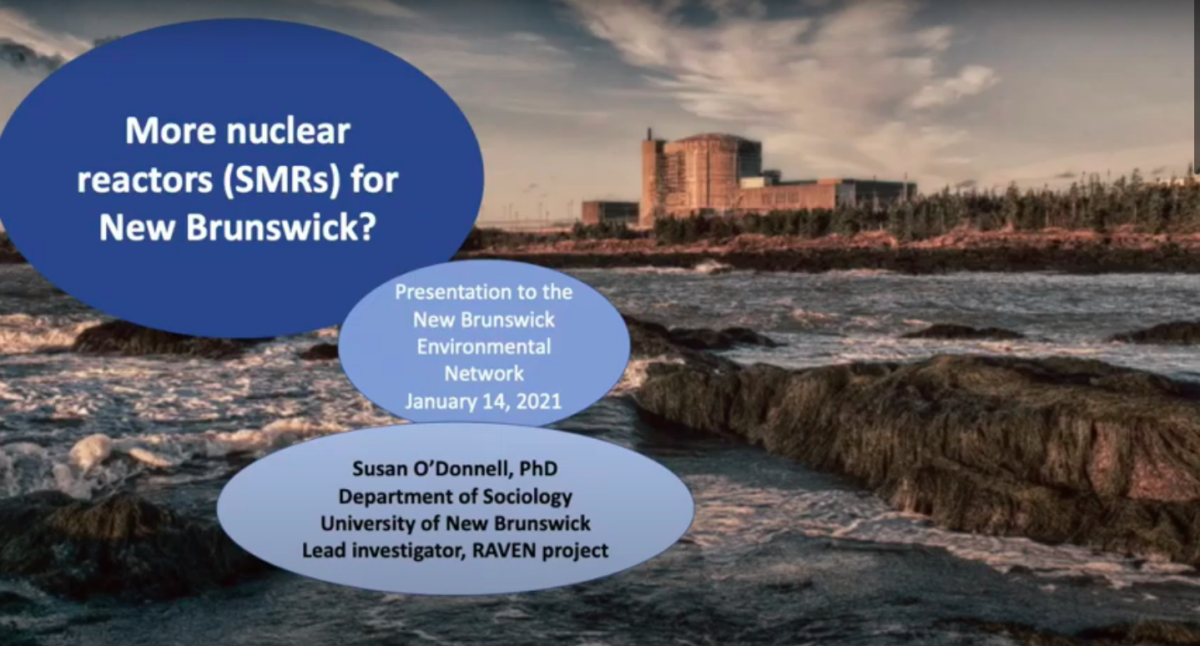
The province and NB Power are promoting two more nuclear reactors (SMRs), to be built next to the existing reactor at Point Lepreau on the Bay of Fundy.
On Jan. 14, the New Brunswick Environmental Network (NBEN) invited Susan O’Donnell, CRED-NB member and leader of the RAVEN project at the University of New Brunswick, to make a presentation about the proposed nuclear reactors.
The video (31 minutes) is here:
Big questions about claims of “recycling” nuclear waste in NB
The CBC today published an interview with Dr. Allison Macfarlane, expert in nuclear waste issues. The article explains that there is no scientific basis to claims by NB Power and the NB government that one of the new nukes will “recycle” Lepreau’s used fuel / high-level nuclear waste. Read it here.