
Governments and other nuclear proponents are failing both Indigenous and settler communities by promoting sales and publicity material about small modular nuclear reactors (SMNRs) instead of sharing facts by independent researchers not tied to the industry. A commentary by Peskotomuhkati Chief Hugh Akagi and CRED-NB core member Susan O’Donnell was published by The Hill Times, the Telegraph Journal and the NB Media Co-op. Read it HERE.
Author: CREDNB
Share your comments about the ARC-100 nuclear project
Today the NB government opened the first opportunity for public comment on NB Power’s ARC Small Modular Nuclear Reactor Demonstration Project proposed for Point Lepreau. During the next 30 days, First Nations and the general public have the opportunity to ensure that their concerns help to determine the topics that NB Power studies and reports on during the Environmental Impact Assessment process.
HERE is the page on our website about the ARC-100 experiment and many of the concerns we have about the project. If you share these concerns, please submit them to the government so that the impact assessment will include these topics.
How to send your comments? It’s simple: send them in an email to EIAEIE@gnb.ca. There is no word limit. The comments deadline is Oct. 28.
CRED-NB is engaging in this process, and we encourage everyone to share your concerns and thoughts. You don’t have to be a nuclear expert to voice your concerns about the safety, environmental, economic, cultural, security, and intergenerational concerns you may have about the potential impacts of this project. It’s us and those who will follow us that will live with – and pay for – those impacts.
Please share this notice widely with your networks.
Fredericton, Thursday, October 12 @ STU– Professor M.V. Ramana: “Nuclear Energy and the Bomb”
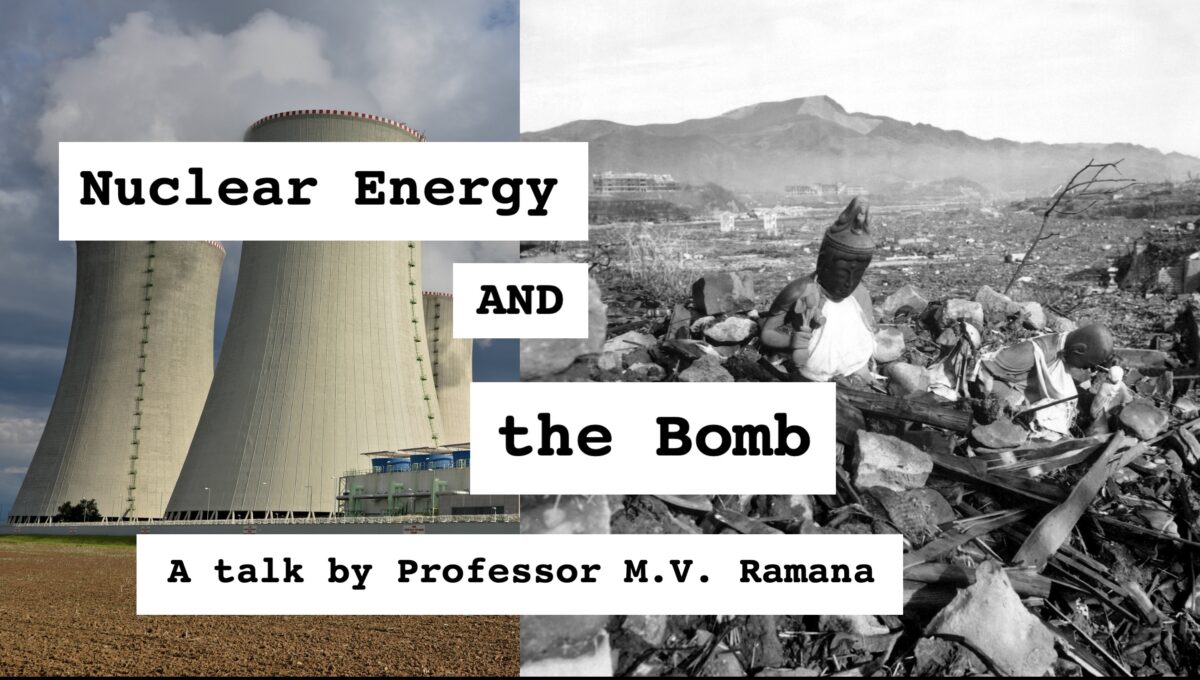
When thinking about energy transitions, the issue of nuclear weapons rarely comes to mind. Yet the connections between generating nuclear energy and the ability to make nuclear weapons have been evident since Hiroshima and Nagasaki were bombed. One connection is separating plutonium from used nuclear fuel, the technology proposed for Point Lepreau in New Brunswick. Other connections include the overlap in technical expertise and institutions.
M.V. Ramana is the Simons Chair in Disarmament, Global and Human Security and Professor at the School of Public Policy and Global Affairs, at the University of British Columbia in Vancouver, Canada.
7pm • Kinsella Auditorium • 9 Duffie Drive • Fredericton • More info HERE.
Everyone is invited to this free public talk at St. Thomas University in Fredericton. Hosts are the CEDAR project and the Environment and Society Program at St. Thomas University and co-hosts the International Physicians for the Prevention of Nuclear War Canada (IPPNWC), the Coalition for Responsible Energy Development in New Brunswick (CRED-NB) and the NB Media Co-op.
CRED-NB presentation on Clean Affordable Electricity for New Brunswick
The NB Legislature’s Standing Committee on Climate Change and Environmental Stewardship met to study a clean energy strategy for New Brunswick. CRED-NB core member Tom McLean presented for our group on September 27, 2023. Here’s the archive:
Video of presentation
NB Power has its head stuck in uranium

NB Power seems to want to be a nuclear utility no matter how much it costs or whether or not the nuclear technology works because… well, just because. The utility’s 2023 Integrated Resource Plan (IRP) released in July states that small modular nuclear reactors (SMRs) are critical to developing a clean and cost-effective power grid in New Brunswick, although NB Power does not know when, or if, SMRs will become available or the cost.
Read the full article published on Sept. 1 by the NB Media Co-op, HERE. A revised version was published by the Telegraph Journal on Sept. 28.
11 Reasons Why Nuclear Power Has No Future

Nuclear power is dirty and dangerous now and for many generations to come.
Read or download 11 Reasons Why Nuclear Power Has No Future – with links to references and supporting materials.
NB Power is kicking the can down the road while the planet burns
For Immediate Release
Coalition for Responsible Energy Development in New Brunswick
NB Power is kicking the can down the road while the planet burns
Rothesay, New Brunswick, August 3, 2023 – The Coalition for Responsible Energy Development in New Brunswick (CRED-NB) is surprised that NB Power would produce a plan (IRP 2023) for the future electrical grid dependent on a nuclear technology that may never exist. At the same time, NB Power is rejecting the most obvious next step: accepting the federal subsidy for the Atlantic Loop to secure a regional electricity infrastructure for New Brunswickers.
In the presentation in February by CRED-NB to the NB Legislative Assembly Standing Committee on Climate Change and Environmental Stewardship, we quoted the authoritative National Academies’ November 2022 report on advanced reactors: molten salt and sodium-cooled SMRs will have difficulty achieving commercial operations by 2050.
Yet the NB Power plan depends on two startup companies, Moltex from the U.K. and ARC from the U.S., neither of which has ever built a nuclear reactor, to build a SMR and make it produce electricity on the grid by 2035. We note that last year the target was 2029.
NB Power states in their IRP that: “the costs of SMRs are another significant unknown.” The NuScale SMR design, the closest to deployment in the U.S. is foreshadowing the costs to come. The NuScale SMR has been in development for more than 15 years and construction hasn’t started yet. They won’t start building it until enough customers have signed on, but more are leaving than signing on because costs have skyrocketed. The current estimated cost for NuScale SMRs with a capacity of 462 Megawatts (the same as NB Power wants to put on the grid by 2040) is $9.3-billion. That’s for a water-cooled SMR. Molten salt and liquid sodium metal designs are likely to cost far more.
Meanwhile, the planet is burning, and the clock is ticking. We must support the development of the Atlantic Loop and prioritize affordable, reliable, quickly deployed and proven solutions: energy efficiency and renewable energy technologies with storage. While we’re waiting for these SMR experiments to fail, NB Power is wasting time that we must spend urgently on genuine climate action.
– 30 –
Will an experimental nuclear reactor on the Bay of Fundy escape federal impact assessment?
On June 30, NB Power registered an environmental impact assessment with the province of New Brunswick and filed a licence application with the Canadian Nuclear Safety Commission (CNSC) to prepare a site on the Bay of Fundy for the ARC-100, an experimental small modular reactor (SMR) still in early design.
Making information public about the project – which includes not just a reactor but also new aquatic infrastructure in the Bay of Fundy and new radioactive storage – as well as testing the veracity of claims made about safety, risk and impacts will be difficult if not impossible without a federal Impact Assessment, which has so far been denied.
Relying only on the provincial assessment or the CNSC’s review to inform understandings of adverse effects and impacts is a major step backwards. The provincial process has limited opportunities for public input. The CNSC’s licensing process is narrowly defined by the stage of activity being licensed (i.e., site selection, construction, operations and eventual decommissioning), meaning a review of impacts and opportunities for public engagement are spaced decades apart.
Read the full article by Susan O’Donnell and Kerrie Blaise in the NB Media Co-op HERE.
Update on the ARC-100 project
The Government of New Brunswick just posted online the EIA registration document for the ARC-100 SMR that NB Power proposes to develop at the Point Lepreau nuclear site on the Bay of Fundy. The full document pdf, 297 pages, is HERE.
Some background:
The ARC-100 project is currently exempt from the Impact Assessment Act, so it will not require a federal review. There is currently an outstanding request filed March 31 to Minister Guilbeault from the Sierra Club Canada, We the Nuclear Free North, Protect Our Waterways and CRED-NB. We asked the Minister to designate the project for an Impact Assessment. We are awaiting the response, which is way overdue, from the Impact Assessment Agency of Canada. This was our second attempt for an IA designation. More info HERE.
Without the federal IA, we’re stuck with the NB provincial EIA and CNSC review, which will not cover all the activities within the lifespan of the project, from development through to decommissioning, including project impacts that are direct or incidental to the project. We know that the federal IA is itself inadequate but it would at least give many of us with concerns about the project to bring all our concerns to the public.
Wishful thinking about nuclear energy won’t get us to net zero

This commentary was published by The Hill Times and the NB Media Co-op.
Wishful thinking about nuclear energy won’t get us to net zero
M. V. Ramana and Susan O’Donnell
On June 20, the Canada Energy Regulator (CER) released its 2023 Canada’s Energy Future report, developing scenarios for a path to net zero by 2050. These scenarios project roughly a tripling of nuclear energy generation capacity in Canada by 2050, seemingly reinforcing former Natural Resources Minister Seamus O’Regan’s statement in 2020 that there is “no path to net-zero without nuclear.”
However, underlying both the scenarios and O’Regan’s contention is wishful thinking about the economics of nuclear energy and how fast nuclear power can be scaled up.
The new nuclear capacity that the report envisions consists of so-called small modular nuclear reactors (SMRs), which have so far not been built in Canada. Aside from refurbishing existing CANDU reactors, the CER does not think any more standard sized nuclear reactors will be built in Canada. Most of this buildup is to happen between 2035 and 2050, meaning that nuclear power will not help meet the government’s stated goal of decarbonizing the electricity grid by 2035.
But can SMRs be built rapidly after 2035? Only two crown companies in the business of generating electricity for the grid have proposed to build SMRs: NB Power in New Brunswick and Ontario Power Generation (OPG).
The reactor designs proposed for New Brunswick are cooled by molten salts and liquid sodium metal. Despite decades of development work and billions invested, major technical challenges have prevented molten salt reactors and sodium cooled reactors from commercial viability, making it highly unlikely that the New Brunswick designs can be rapidly deployed in the time frame envisioned by the CER.
Assuming that OPG’s chosen design – the 300-megawatt BWRX-300 – is the one to be deployed widely, then around 70 SMR units would need to be built and operating effectively on the grid between 2030 and 2050. The BWRX-300 design is yet to be even approved by any safety regulator anywhere in the world.
But the report has an even more serious problem: economics. Nuclear power cannot compete economically, which is why its share of global electricity generation has declined from 17.5 percent in 1996 to 9.8 percent in 2021. Because SMRs lose out on economies of scale, they will produce even more expensive electricity.
The CER’s scenarios for nuclear power are based on the Electricity Supply Model, meant to calculate “the most efficient and cost-effective way to meet electricity demand in each region.” Such models are widely used in energy analysis and policy making but their utility depends on the validity of the assumptions used; garbage in, garbage out.
Two key parameters underlie the report’s scenarios—the capital cost of an SMR and how that cost evolves with time. The CER’s assumptions in the two Net Zero scenarios are that a SMR costs $9,262 per kilowatt in 2020, falling to $8,348/kW by 2030, and to $6,519/kW by 2050. Both these assumptions are ridiculously out of touch with the real world.
Consider the CAREM-25 SMR designed to feed 25 megawatts of electricity into the grid, being built in Argentina since 2014. Its original cost estimate of $446 million (2014 US dollars), has escalated significantly since then, but even using these original costs, the project costs nearly $30,000 per kilowatt in 2022 Canadian dollars.
The NuScale design, arguably the closest to deployment in the United States, has been in development since 2007 with the build not yet begun. The January 2023 cost estimate for six NuScale SMRs with a total capacity of 462 megawatts is $9.3 billion, or over $26,000 per kilowatt in Canadian dollars.
Finally, the cost of the 5-megawatt Micro Modular Reactor Project at Chalk River in Ontario was estimated by the proponent in May 2020 to be between $100 and $200 million. In 2022 Canadian dollars, that works out to $22,000 to $44,000 per kilowatt.
In other words, the CER’s cost assumptions are wild underestimates, 2.5 to four times lower than the current evidence.
The second incorrect assumption is that costs will decrease with time. Both in the United States and France, the countries with the highest number of nuclear plants, the trend was the opposite: costs went up, not down, as more reactors were built. In both countries, the estimated construction cost of the most recent reactors being built—Vogtle in the United States, and Flamanville-3 in France—have broken new records.
We need government organizations to do better. The climate problem is too serious for such unrealistic modelling exercises. Wishful thinking will only thwart our ability to act meaningfully to lower emissions rapidly.
M.V. Ramana is the Simons Chair in Disarmament, Global and Human Security and professor at the School of Public Policy and Global Affairs, University of British Columbia. Susan O’Donnell is adjunct research professor and primary investigator of the CEDAR project at St. Thomas University in Fredericton.