Spreading the Bomb – Will Ottawa revisit Canada’s support for plutonium reprocessing?

Today, the Canadian Coalition for Nuclear Responsibility and researchers from five universities are urging Ottawa to reconsider its financial and political support for reprocessing in Canada – extracting plutonium from used nuclear fuel.

Plutonium is one of the key materials needed to make nuclear weapons—the other alternative is highly enriched uranium. Plutonium is created as a byproduct in nuclear reactors. Once extracted, plutonium can be used either as a nuclear fuel or as a nuclear explosive. The chemical process used to separate plutonium from other radioactive substances produced in nuclear reactors is called reprocessing.

In 1974 India used plutonium from a Canadian reactor to explode an atomic bomb in an underground test. The entire world was shocked to realize that access to plutonium and the making of an atomic bomb may be separated only by an act of political will.

Last week, a House of Commons committee released a report recommending that the government “work with international and scientific partners to examine nuclear waste reprocessing and its implications for waste management and [nuclear weapons] proliferation vulnerability.”

The recommendation by the House of Commons committee echoes numerous calls by civil society groups and by U.S. and domestic researchers after Canada announced a $50.5 million grant to the Moltex corporation in March 2021 for a New Brunswick project to develop a plutonium reprocessing facility at the Point Lepreau nuclear site on the Bay of Fundy.

Allowing plutonium reprocessing in Canada sends a dangerous signal to other countries that it is OK for them to extract plutonium for commercial use. Such a practice increases the risk of spreading nuclear weapons capabilities to countries that currently do not possess the means to make nuclear weapons. The risk is that much greater if Canada sells the technology, as is currently envisaged.

“By supporting the implementation of reprocessing technology intended for export, in connection with a plutonium-fuelled nuclear reactor, without regard for the weapons implications, Canada may be once again spreading the bomb abroad,” says Dr. Gordon Edwards, President of the Canadian Coalition on Nuclear Responsibility.

Reprocessing is often justified as a solution to the problem of dealing with nuclear waste, but in reality, it only makes the challenge even harder. Instead of having all the radioactive materials produced in solid spent fuel, these get dispersed into multiple solid, liquid and gaseous waste streams.­­­

Researchers from the University of British Columbia, Princeton University and three New Brunswick universities are supporting the call for an international review. “We’re heartened that the House of Commons Committee listened to the concerns about plutonium reprocessing raised by numerous experts and concerned citizens,” says Dr. Susan O’Donnell, Adjunct Professor at the University of New Brunswick.

Dr. Edwards cited three letters written to Prime Minister Justin Trudeau by nine prominent nonproliferation experts, including plutonium expert Dr. Frank von Hippel. “The Prime Minister’s failure to respond indicates an appalling lack of good governance on the proliferation of nuclear weapons,” said Dr. Edwards.

To date the government has not responded to the letters or even acknowledged the monumental significance of the nuclear weapons connection with reprocessing. The House of Commons Science and Research Committee cited the letters by Dr. von Hippel and others as rationale for their recommendation to conduct the review.

Commercial reprocessing has never been carried out in Canada but in the past, Canada has been complicit in the production of nuclear weapons. During the Cold War some reprocessing was done at the federal government’s Chalk River Nuclear Laboratory, at a time when Canada sold both uranium and plutonium to the US army for use in nuclear weapons. These operations resulted in a permanent legacy of nuclear waste and radioactive contamination in Canada.

The first reactors were built to produce plutonium for bombs. The first reprocessing plants were built to extract plutonium to be used as a nuclear explosive. Following India’s use of plutonium from a nuclear reactor supplied by Canada in its 1974 weapon test, the United States banned commercial plutonium reprocessing in 1977 to reduce the danger of weapons proliferation.

Canada has had an informal ban on reprocessing since the 1970s. A 2016 Canadian Nuclear Laboratories report stated that reprocessing used CANDU fuel would “increase proliferation risk.” That CNL admission was fully confirmed in a major report (330 pages) released three months ago by a U.S. National Academy of Sciences. The expert panel reached a consensus that the reprocessing technology proposed for New Brunswick by the Moltex corporation “does not provide significant proliferation resistance.”

The need for an independent international review is urgent, as Moltex announced just last week that the company is seeking an additional $250 million in government funding.

The researchers supporting the call for an international review of plutonium reprocessing in relation to the spread of nuclear weapons are:

Dr. Gordon Edwards, President, Canadian Coalition for Nuclear Responsibility

Dr. Susan O’Donnell, Adjunct Professor and Principal Investigator of the Rural Action and Voices for the Environment [RAVEN] project, University of New Brunswick

Dr. Janice Harvey, Assistant Professor, Environment & Society Program, St. Thomas University

Dr. Jean-Philippe Sapinski, Assistant Professor of Environmental Studies, Université de Moncton

Dr. M.V. Ramana, Professor and Simons Chair in Disarmament, Global and Human Security, School of Public Policy and Global Affairs, University of British Columbia

Dr. Frank von Hippel, Senior Research Physicist and Professor of Public and International Affairs Emeritus, Program on Science & Global Security, Princeton University

-30-

Contest promoting nuclear energy in schools harms critical thinking

The nuclear industry has spread its tentacles everywhere, including in our school system. An open letter written by educators and published by the NB Media Co-op is critical of a contest promoted by the New Brunswick government to high-school students that promotes nuclear energy.

“For educators, teaching students how to deconstruct bias and how to enhance critical thinking skills is an overarching curriculum mandate. Information literacy is tied to critical thinking skills and teachers have an obligation to challenge students particularly to consider a wide variety of resources in their research projects. The promotional contest supported by the New Brunswick government on the topic of small modular nuclear reactors, also known as SMRs, breaks every rule in the book.” Read the commentary HERE.

CRED-NB at the New Brunswick legislature

On Feb. 14, our Coalition made our case against SMRs to the MLAs on the Climate Change and Environmental Stewardship committee of the Legislative Assembly of New Brunswick. Our presentation used the best scientific analysis to critique the “advanced” SMRs for development in New Brunswick. CRED-NB core member Susan O’Donnell presented on behalf of the Coalition. Our written presentation in English is HERE (and HERE in French). The video of the session is on YouTube, HERE. Check out the video to learn more about the SMR plans and what our elected representatives have to say about them.

There were 13 presentations over two days. Other presentations to watch for are, on Feb. 14: J.P. Sapinski, M.V. Ramana. On Feb. 15: Gordon Edwards, Chief Hugh Akagi + Chief Ron Tremblay + Kim Reeder, and Louise Comeau + Moe Quershi. Each has a one-hour time slot, with 20 minutes by presenters followed by 40 minutes of Q&A with the MLAs on the committee. The full schedule of presentations is HERE. The link to the video archive is HERE (scroll through or search to find the webcast archive from Feb. 14 and 15).

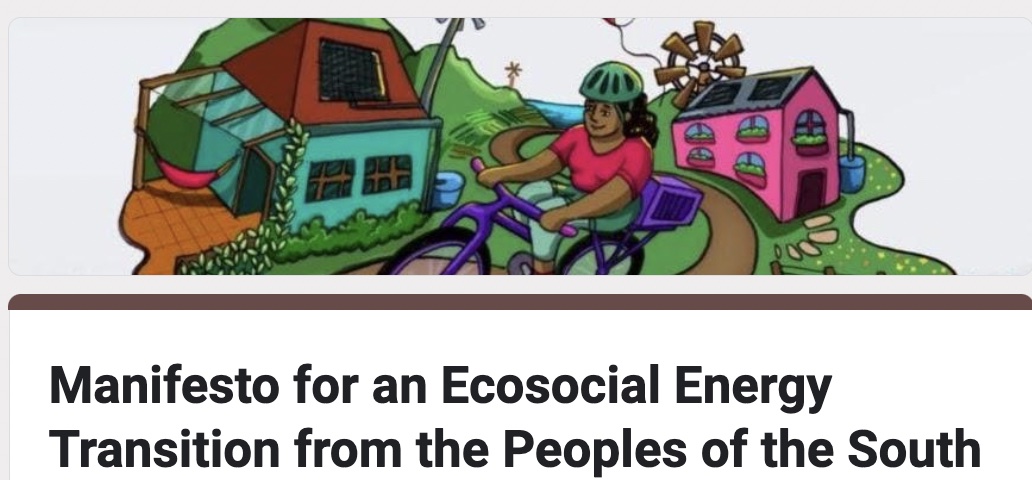
CRED-NB endorses the Manifesto for an Ecosocial Energy Transition from the Peoples of the South

One of CRED-NB’s core guidelines is: “Support solidarity actions with communities experiencing harmful impacts of our energy choices in New Brunswick, across Canada and globally.” The transition to real clean energy has impacts that extend well beyond New Brunswick’s borders.

This week, a coalition of groups from the Global South released the “Manifesto for an Ecosocial Energy Transition from the Peoples of the South,” with eight core demands. CRED-NB has endorsed it. The Manifesto states that “clean energy transitions” of the North that have put even more pressure on the Global South to yield up cobalt and lithium for the production of high-tech batteries, balsa wood for wind turbines, land for large solar arrays, and new infrastructure for hydrogen megaprojects. This decarbonization of the rich, which is market-based and export-oriented, depends on a new phase of environmental despoliation of the Global South, which affects the lives of millions of women, men, and children, not to mention non-human life. In this way, the Global South has once again become a zone of sacrifice, a basket of purportedly inexhaustible resources for the countries of the North. Read the full Manifesto and support it, HERE.

Plutonium reprocessing is dirty and dangerous. So why do it beside the Bay of Fundy?

Plutonium reprocessing has never been done commercially in Canada – and it was informally banned in the 1970s. Now the New Brunswick government and NB Power are supporting a plan to reprocess plutonium at the Point Lepreau Nuclear site. Reprocessing operations are the most contaminated sites in the world. So why are we planning to do it at all, and why beside the Bay of Fundy? We need to stop this plan now. Send a letter to Prime Minister Justin Trudeau, HERE.

For more information, including fact sheets, videos and links to scientific reports, check out the website of the national campaign to ban plutonium reprocessing in Canada HERE. The direct link to the factsheet on reprocessing and environmental contamination is HERE. Check out our webinar with four international experts on the topic on Feb. 28, Plutonium: How Nuclear Power’s Dream Fuel Turned into a Nightmare, info HERE.

New Brunswick’s SMR plans finally get a public airing: webcast on Feb. 14 and 15

Finally. Finally! On Feb. 14 and 15, the public has a chance to learn more about plans by the NB government and NB Power to build two experimental nuclear reactors (SMRs) at Point Lepreau on the Bay of Fundy. The NB Legislature’s standing committee on Climate Change and Environmental Stewardship is meeting that week, including two days of hearings on SMRs that will be webcast. Please tune in to learn more about the SMR plans and what our elected representatives have to say about them.

The 13 presentations over the two days each have a one-hour time slot, with 20 minutes by presenters followed by 40 minutes of Q&A with the MLAs on the committee. CRED-NB will be represented by Susan O’Donnell at 11am on Tuesday, Feb. 14. The full schedule of presentations is HERE. The link to the webcast is HERE (the webcast link will appear when the Committee is in session).

Video: Ban Plutonium Reprocessing in Canada

More than a dozen environmental groups including CRED-NB co-sponsored a webinar hosted by Nuclear Waste Watch: Ban Plutonium Reprocessing in Canada. The international expert panel included M.V. Ramana from the University of British Columbia, Ray Acheson Ray Acheson from Reaching Critical Will, the disarmament program of the Women’s International League for Peace and Freedom and environmental journalist Joshua Frank, author of the recently released Atomic Days: The Untold Story of the Most Toxic Place in America (Haymarket Book, 2022). Watch the video HERE.

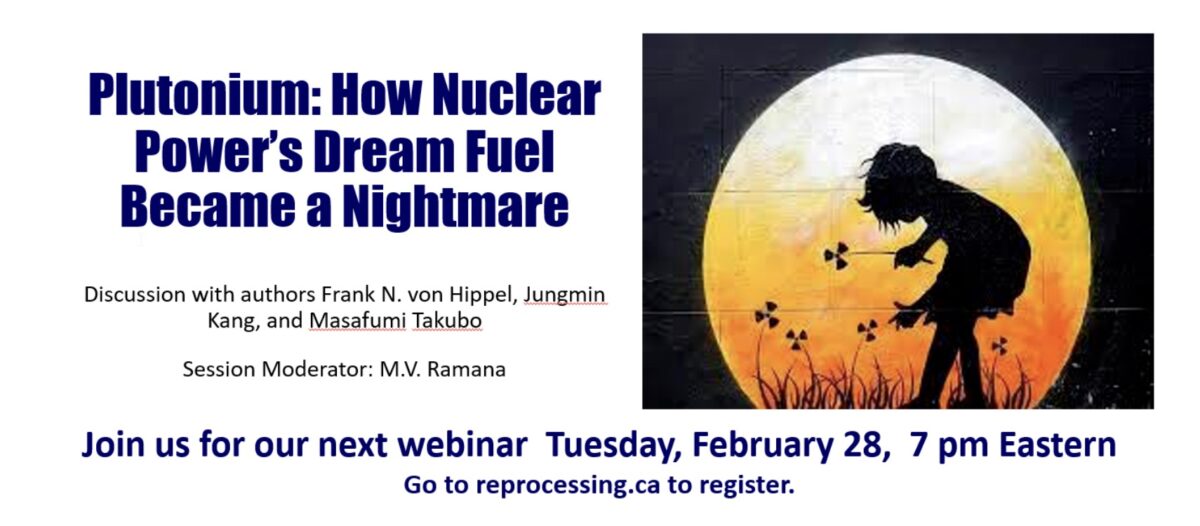
Webinar – Plutonium: How Nuclear Power’s Dream Fuel Turned Into a Nightmare

Tuesday, Feb. 28 @ 8pm Atlantic. NB Power and the NB government are supporting a plan to build a plutonium reprocessing plant at Point Lepreau on the Bay of Fundy. To inform the public about this development, CRED-NB is co-sponsoring a webinar featuring a conversation with international experts on plutonium reprocessing and nuclear weapons proliferation. With Frank von Hippel, senior research physicist and professor of public and international affairs emeritus with Princeton’s Program on Science & Global Security; Jungmin Kang, a former chairman of South Korea’s Nuclear Safety and Security Commission; Masafumi Takubo, an independent nuclear policy analyst based in Tokyo and member of the International Panel on Fissile Materials; and M. V. Ramana, Professor and Simons Chair in Disarmament, Global and Human Security at the School of Public Policy and Global Affairs, University of British Columbia. More info HERE. Register for the webinar HERE.

CRED-NB: Comments on NB Power’s proposed rate hike

CRED-NB representative Gail Wylie (Council of Canadians) prepared a comment to the Energies and Utilities Board (EUB) responding to the proposed NB Power rate hike. Read or download the submission HERE. The document outlines the choices available to NB Power moving forward and includes a history of NB Power’s nuclear activities and a critique of its plans to develop SMRs.

CRED-NB member Dave Thompson of Leap Forwards made an oral presentation, text HERE. The Conservation Council of New Brunswick also submitted a document to the EUB, details HERE.

Small modular nuclear reactors are unsafe

CRED-NB core member Ann McAlister, representing Council of Canadians Saint John, was featured in an NB Media Co-op article and video. Ann explained the history and outcome of CRED’s application to the federal Environment minister requesting that the SMRs planned for Point Lepreau in New Brunswick should undergo a federal impact assessment. Read the article HERE.