Civil Society Groups Reject Canada’s Radioactive Waste Policy

Ottawa – Civil society groups are expressing profound disappointment in the federal government’s recently released radioactive waste policy, after Natural Resources Canada quietly posted the final policy to a government website on Friday morning.

Organizations who were intensively engaged in the policy development process between November 2020 and May 2022 are calling the policy a handover to the nuclear industry and say it fails to meet international standards or the public’s expectations.

“It is a fundamental failure. It leaves the industry in charge and the public and the environment at risk. This policy is a betrayal of science and public trust,” said Dr. Ole Hendrickson, for the Sierra Club Canada Foundation.

“This final version of the radioactive waste policy sentences us to ten years of nuclear industry control. It is a complete failure on the highest priorities for a national radioactive waste policy – to establish a national registry of waste and its characteristics and its cross-border movement, to assert federal authority over radioactive waste management strategies, and to require the perpetual care of reactor fuel waste”, commented Brennain Lloyd, Project Coordinator for the Northern Ontario based coalition Northwatch.

The revised policy follows the International Atomic Energy Agency having conducted a peer review of Canada’s nuclear regulatory framework in 2019, and recommending that that Canada “enhance” its 3-bullet-point radioactive waste policy framework from 1996.

“The federal government’s new radioactive waste policy is not protective of the public and the environment. It fails to even approach meeting the legitimate expectations of the public and civil society,” said Theresa MacClenaghan, Executive Director and Senior Counsel at the Canadian Environmental Law Association.

The radioactive waste policy released on Friday was practically silent on the crucial issue of reprocessing, saying that while there is currently no reprocessing undertaken in Canada, if there should be reprocessing undertaken in the future the just-released policy would extend to address the wastes from reprocessing.

“Reprocessing – that is, extracting plutonium from high level nuclear waste – is described as outside of the scope of the new policy. At the same time, the government is promoting two nuclear projects in New Brunswick that will use this controversial technology. Abdicating
responsibility is not only poor governance but also reckless and dangerous. The research is clear that reprocessing increases the risk of nuclear weapons proliferation, in addition to its environmental risks,” said Susan O’Donnell, PhD, spokesperson for the Coalition for Responsible Energy Development in New Brunswick.

Dr. Gordon Edwards, President of the Canadian Coalition for Nuclear Responsibility, summarized concerns about the lack of oversight of the nuclear industry, which the organizations say will be perpetuated by the 2023 policy: “After a ten-year investigation, with public hearings in five provinces, a government-appointed panel unanimously recommended that Canada needs an independent agency for radioactive wastes management. That same need was recently communicated to Ottawa by dozens of public interest organizations across Canada. Without such an agency, the government’s policy is powerless to protect future generations from these persistent poisons.”

Nuclear Waste Watch facilitated the engagement of more than a hundred organizations in the policy review process,
• convening a series of roundtable discussions with Natural Resources Canada, and
• bilingual national preparatory sessions for each of the Natural Resources Canada’s four discussion papers and the draft policy, and
• preparing and releasing an Alternative Policy in response to Natural Resouces’ draft policy, based on the input of the hundreds of participants.

-30-

Concern with NB Power Exploring Partnership with Ontario Power Generation

CRED-NB sent a letter today to Premier Higgs to express concern about the report that NB Power is exploring a partnership with OPG. Here is the text of the letter.

Dear Premier Higgs:

The Coalition for Responsible Energy Development in New Brunswick is concerned about the report March 29th that NB Power is exploring a partnership with Ontario Power Generation, including a possible ownership stake in the Lepreau nuclear facility.

Our primary concern is that you are quoted by CBC, indicating that these significant operational and ownership “discussions with OPG have been (happening) for years.” This has been taking place without any democratic participation by the New Brunswick public – i.e., rate payers and owners of NB Power as a Crown utility. Even more shocking, the NB public has had no information that it has even been taking place! As recently as the February EUB hearings, dealing with NB Power’s application for an 8.9% electricity rate increase, there has been no reference to these ‘partnership’ discussions. The apparent intent of a ‘partnership’ is to address capacity problems at Point Lepreau Nuclear Generating Station, which are the main contributor to NB Power’s debt and the rate increase application.

We urge you to immediately begin public sharing of the salient features under consideration for any negotiations, including any ‘red lines’, that would not be crossed in any future agreement, in order to ensure New Brunswick’s interests are protected.

Secondly, we call on your government, as owner of the Crown utility, to hold public hearings on the costs, benefits, and social implications of any ‘partnership’ with OPG, while providing the NB public with access to related expertise, in order to ensure transparency for these considerations. The New Brunswick Energy and Utilities Board must engage the public’s input on any decisions regarding a ‘partnership’, in order to carry out its role of ensuring the public interest is served.

A ‘partnership’ decision should not be taken in the primary interests of any one sector of the NB economy which might benefit by it, or the primary interests of another province’s crown utility, as referenced in Ken Hartwick’s (OPG’s CEO) email. It must be guided by the best decision for the common good of New Brunswickers and the NB public must be encouraged to weigh in.

A particular point of concern is your reference to getting better capacity “and turn that into a partnership for future generation?” Ontario critics have already documented OPG’s irrational commitment to refurbishment and expansion of the expensive nuclear power option in Ontario, while failing to pursue cost effective, reliable and truly ‘clean’ renewable options. Louise Comeau’s research shows clearly that nuclear power is not the preferred option by New Brunswickers. New Brunswick’s utility needs to be driven by New Brunswickers’ preferences, not the priorities of Ontario’s Crown utility.

Thank you for your attention to these concerns. We hope you will act promptly and transparently on our recommendations. Please keep us informed of your communication and engagement plans.

Sincerely,
Gail Wylie
Chair, Coalition for Responsible Energy Development -New Brunswick

Cc:
Susan Holt, Leader Liberal Party of New Brunswick
David Coon, Leader Green Party of New Brunswick
François Beaulieu, Chairperson and CEO, New Brunswick Energy and Utilities Board
Richard A. Williams, Public Intervener, New Brunswick Energy and Utilities Board

Information regarding potential safety concerns and risks of the ARC-100 fuel

A member of the public asked CRED-NB about the type of fuel that the ARC-100 will use, and if the intention is to reprocess the used ARC-100 fuel. Their questions arose after a presentation at which NB Power said there is no intention to reprocess the ARC-100 used fuel.

CRED-NB prepared a memo to share information about the ARC-100 design, the fuel for the design, “breeder” reactors, the plans to reprocess the used fuel, and risks and some implications for the New Brunswick public.
You can read or download the memo HERE.

Groups oppose funding for small modular nuclear reactors in federal budget

Ottawa, Monday, March 27, 2023 – Environmental and civil society groups are giving a thumbs-down after the federal government announced new funding on Friday towards the development of small modular nuclear reactors (SMRs). The groups will be looking closely at the numbers in Tuesday’s budget.

The “Prime Minister Trudeau and President Biden Joint Statement,“ issued on Friday March 24, committed Canada to provide funding and in-kind support for a US-led program to promote SMRs.

The Canadian government’s Strategic Innovation Fund has already given close to $100 million to corporations working on experimental SMR technologies. In addition, the Canada Infrastructure Bank has committed $970 million to Ontario Power Generation’s plan for a 300-megawatt SMR at Darlington. Federal funding is benefiting US-based companies GE-Hitachi and Westinghouse, and Canada’s SNC-Lavalin, among others.

All the funded SMR projects are still in the research and development phase. Worldwide, no SMRs have ever been built for domestic use.

In addition, the federal government is giving Atomic Energy of Canada Limited $1.35 billion a year to conduct nuclear research and development and to manage its toxic radioactive waste. Nearly all this funding is transferred to a consortium of SNC-Lavalin and two US-based companies (Fluor and Jacobs) that that are heavily involved in nuclear weapons and SMR research.

Over 100 groups from all across Canada have criticized the federal government’s plan to promote SMR nuclear technology, stating that:

  • SMRs are a dirty, dangerous distraction that will produce radioactive waste of many kinds. Especially worrisome are those proposed reactors that would extract plutonium from irradiated fuel, raising the spectre of nuclear weapons proliferation.
  • SMRs will take too long to develop to address the urgent climate crisis in the short time frame necessary to achieve Canada’s goals.
  • SMRs will be much more expensive than renewable energy and energy efficiency. Small reactors will be even more expensive per unit of power than the current large ones, which have priced themselves out of the market.
  • Nuclear power creates fewer jobs than renewable energy and efficiency. Solar, wind and tidal power are among the fastest-growing job sectors in North America.

The International Energy Agency forecasts that 90% of new electrical capacity installed worldwide over the next five years will be renewable.

The federal government needs to invest urgently in renewables, energy conservation and climate action, not slow, expensive, speculative nuclear technologies.

QUOTES:

“Taxpayer dollars should not be wasted on a future technology whose time is past, like nuclear reactors, when truly clean renewable solutions are up-and-running and getting more affordable all the time.” – Dr. Gordon Edwards, Canadian Coalition for Nuclear Responsibility

“Let’s compete to be world leaders in renewables. Pouring public funding into speculative reactor technologies is sabotaging our efforts to address the climate crisis.” – Dr. Ole Hendrickson, Sierra Club Canada Foundation

“The SMR technologies are all at the early R&D stage, yet the funding is not following good governance practices by requiring high standards of peer review.“ – Dr. Susan O’Donnell, Coalition for Responsible Energy Development in New Brunswick

– 30 –

—————————-

Les groupes s’opposent au financement des petits réacteurs nucléaires modulaires dans le budget fédéral

Ottawa, le 27 mars 2023 – Des groupes environnementaux et de la société civile s’opposent à l’annonce faite vendredi par le gouvernement fédéral d’un nouveau financement pour le développement de petits réacteurs nucléaires modulaires (PRNM). Les groupes examineront de près les chiffres du budget de mardi.

La “Déclaration conjointe du Premier ministre Trudeau et du président Biden”, publiée le vendredi 24 mars, engage le Canada à fournir un financement et un soutien en nature à un programme dirigé par les États-Unis visant à promouvoir les PRNM.

Le Fonds stratégiques pour l’innovation du gouvernement canadien a déjà accordé près de 100 millions de dollars à des entreprises travaillant sur des technologies PRNM expérimentales. En outre, la Banque de l’infrastructure du Canada s’est engagée à verser 970 millions de dollars à l’Ontario Power Generation pour la construction d’un réacteur PRNM de 300 mégawatts à Darlington. Le financement fédéral profite notamment aux entreprises américaines GE-Hitachi et Westinghouse, ainsi qu’à l’entreprise canadienne SNC-Lavalin.

Tous les projets de PRNM financés sont encore en phase de recherche et de développement. Au niveau mondial, aucun PRNM n’a jamais été construit pour un usage domestique.

En outre, le gouvernement fédéral verse à Énergie atomique du Canada limitée 1,35 milliard de dollars par an pour mener des activités de recherche et de développement dans le domaine nucléaire et pour gérer ses déchets radioactifs toxiques. La quasi-totalité de ces fonds est transférée à un consortium composé de SNC-Lavalin et de deux entreprises américaines (Fluor et Jacobs), fortement impliquées dans la recherche sur les armes nucléaires et les PRNM.

Plus de 100 groupes de tout le Canada ont critiqué le plan du gouvernement fédéral visant à promouvoir la technologie nucléaire des PRNM :

• Les PRNM sont une distraction, une technologie sale et dangereuse, une qui produira des déchets radioactifs de toutes sortes. Les réacteurs proposés qui extrairaient du plutonium du combustible irradié sont particulièrement inquiétants, car ils font planer le spectre de la prolifération des armes nucléaires.

• Le développement des PRNM prendra trop de temps pour répondre à l’urgence de la crise climatique dans le court laps de temps nécessaire pour atteindre les objectifs du Canada.

• Les PRNM seront beaucoup plus coûteux que les énergies renouvelables et l’efficacité énergétique. Les petits réacteurs seront encore plus chers par unité d’énergie que les grands réacteurs actuels, qui n’ont pas d’acheteurs en raison de leur coût excessif..

• L’énergie nuclé aire crée moins d’emplois que les énergies renouvelables et l’efficacité énergétique. Les énergies solaire, éolienne et marémotrice font partie des secteurs d’emploi qui connaissent la plus forte croissance en Amérique du Nord.

• L’Agence internationale de l’énergie prévoit que 90 % des nouvelles capacités électriques installées dans le monde au cours des cinq prochaines années seront renouvelables.

Le gouvernement fédéral doit investir d’urgence dans les énergies renouvelables, les économies d’énergie et l’action climatique, et non dans des technologies nucléaires lentes, coûteuses et spéculatives.

CITATIONS :

“L’argent des contribuables ne devrait pas être gaspillé pour une technologie future dont le temps est révolu, comme les réacteurs nucléaires, alors que des solutions renouvelables vraiment propres fonctionnent maintenant et deviennent de plus en plus abordables.” – Gordon Edwards, Ph.D., Regroupement pour la surveillance du nucléaire.

“Soyons compétitifs pour devenir des leaders mondiaux dans le domaine des énergies renouvelables. Verser des fonds publics dans des technologies de réacteurs spéculatives, c’est saboter nos efforts pour faire face à la crise climatique.” – Ole Hendrickson, Fondation Sierra Club Canada

“Les technologies PRNM sont toutes à un stade précoce de R&D, et pourtant le financement ne suit pas les bonnes pratiques de gouvernance en exigeant des normes élevées d’examen par les pairs.” – Susan O’Donnell, Coalition for Responsible Energy Development au Nouveau-Brunswick

No business case for LNG export terminal in New Brunswick

There is no business case for developing an LNG export terminal in the province, according to a study released by Repsol SA, owner of an LNG import terminal on the Bay of Fundy near of Saint John. CRED-NB core member the New Brunswick Anti-Shale Gas Alliance (NBASGA) recalled the unrealistic idea proposed by the New Brunswick premier Blaine Higgs that fracked gas from the province would supply the proposed export facility. Read the NBASGA media release HERE.

Webinar: Community Energy & Energy Democracy

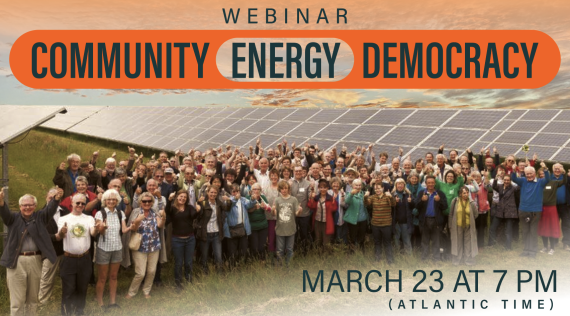
Decentralized and diversified energy systems are more resilient to extreme weather events and geopolitical conflicts. Join Tynette Deveaux, CRED-NB core member with Sierra Club Atlantic chapter, on March 23 @ 7pm Atlantic for a presentation on community energy in Canada and where it fits in the context of the global energy democracy movement. Register HERE.

CRED-NB Supports Climate Emergency Petition and Resolution to Fredericton City Council

CRED-NB is one of a dozen organizations that signed a petition for Fredericton City Council to adopt a Climate Emergency resolution. Read the resolution HERE. The resolution describes some of the effects of climate breakdown and commits Council to maintaining a safe and liveable environment through decarbonization.

Update: The Fredericton City Council reviewed and adopted the resolution in an unanimous vote on March 27. Congrats to all involved.

CRED-NB and SMRs on CBC’s Maritime Noon

SMRs were in the news in February because of the hearings at the NB legislature and the big funding asks from our nuclear startups. Whenever nuclear energy is in the news, CRED-NB tries to be part of the stories, to share information that the government and NB Power are not sharing with the public. This week several CRED-NB members were featured in the CBC radio show Maritime noon. Susan O’Donnell from the UNB RAVEN project was a guest in the Fredericton studio, and callers included Ann McAlister (Council of Canadians Saint John) and Dave Thompson (Leap4ward Saint John). You can listen to the recording HERE (38 minutes).

Moltex’s nuclear ransom note should be rejected

Moltex – a start-up company from the UK, now based in New Brunswick – has sent the government a ransom note. The company wants “more than $250 million in public funding” to develop its small modular nuclear reactor (SMR).

Speaking to the media, the company’s CEO warned “New Brunswick needs to decide if it’s in or out, because it’s a big commitment.” So far Moltex has received $50.5 million from Ottawa, $10 million from New Brunswick, and $1 million from Ontario Power Generation.

We recommend rejecting the ransom demand for more.

Citing an old saying, the economist John Maynard Keynes once observed: “Owe your banker £1000 and you are at his mercy; owe him £1 million and the position is reversed.” So far, Moltex has received only $60 million and is acting as if the federal and provincial governments are already at its mercy. Another $250 million, and these governments will really be on their knees.

How does Moltex have the confidence to make this demand? Ultimately because these governments have drunk the kool-aid offered by a nuclear industry that has been moribund for decades but is still powerful enough to be invited to sing its own praises at House of Commons committee hearings.

Almost exactly thirty years ago, the last new nuclear reactor began producing electricity for the grid. None has been built in Canada since. Desperate to reverse its declining fortunes, the nuclear industry began touting a new generation of reactors it dubs SMRs, using the climate crisis as a cover.

This pitch caught the fancy of Ontario, New Brunswick, Saskatchewan, and Alberta, whose governments signed a memorandum of understanding in 2019 to aggressively promote SMRs as a climate change solution. The following year, the Natural Resources Canada Minister stated there is no path to net zero without nuclear power. Despite much evidence to the contrary, the federal government continues to argue that SMRs are needed for climate action. That mistaken belief in SMRs is what allows companies like Moltex to get public funding and demand more.

The $250 million will certainly not be the last demand. Consider NuScale, the SMR design farthest along in the U.S. regulatory process. In 2012, when NuScale estimated that “it will cost $500 million (U.S.) to obtain approval for its reactors from the Nuclear Regulatory Commission,” the company had already invested USD 100 million in technology development. Fast forward to a decade later: NuScale reports that the “cumulative capital invested to date” is USD 1.4 billion (close to 1.9 billion CAD), with a net loss (i.e., expenditure) of USD 49.6 million just in the third quarter of 2022. And NuScale still has not obtained approval to build its first proposed SMR, projected to start operating in December 2029. Assuming all goes well, NuScale might spend more than 2.5 billion CAD, five times the original estimate, before even starting construction.

NuScale is a pressurized light water reactor design—the most widely deployed reactor design globally. In contrast, Moltex is proposing a reactor design cooled with molten salt. The last time anyone built one of these was at the Oakridge Laboratory in the United States—in the 1960s. That failed experiment provides evidence about how well such reactors might operate: long story short, we can expect lots of problems with molten salt reactors, while they operate and for decades thereafter, as society grapples with the radioactive legacy of the nuclear wastes they would produce.

A recent report by the U.S. National Academies of Sciences, Engineering and Medicine found that SMRs like the Moltex design will confront significant challenges, even for deployment by 2050, and that building such reactors at a large commercial scale will continue to need substantial government and industry investments for decades after that.

The Moltex design has an additional problem: it requires another untested technology to produce the fuel needed for its SMR. Based on a February 2021 presentation to the U.S. National Academies committee, this new technology appears similar to the pyroprocessing process tried for two decades at the Idaho National Laboratory. That experience was meant to prove the viability of pyroprocessing; instead, the significant cost overruns and schedule delays demonstrated “the numerous shortcomings of this technology.”

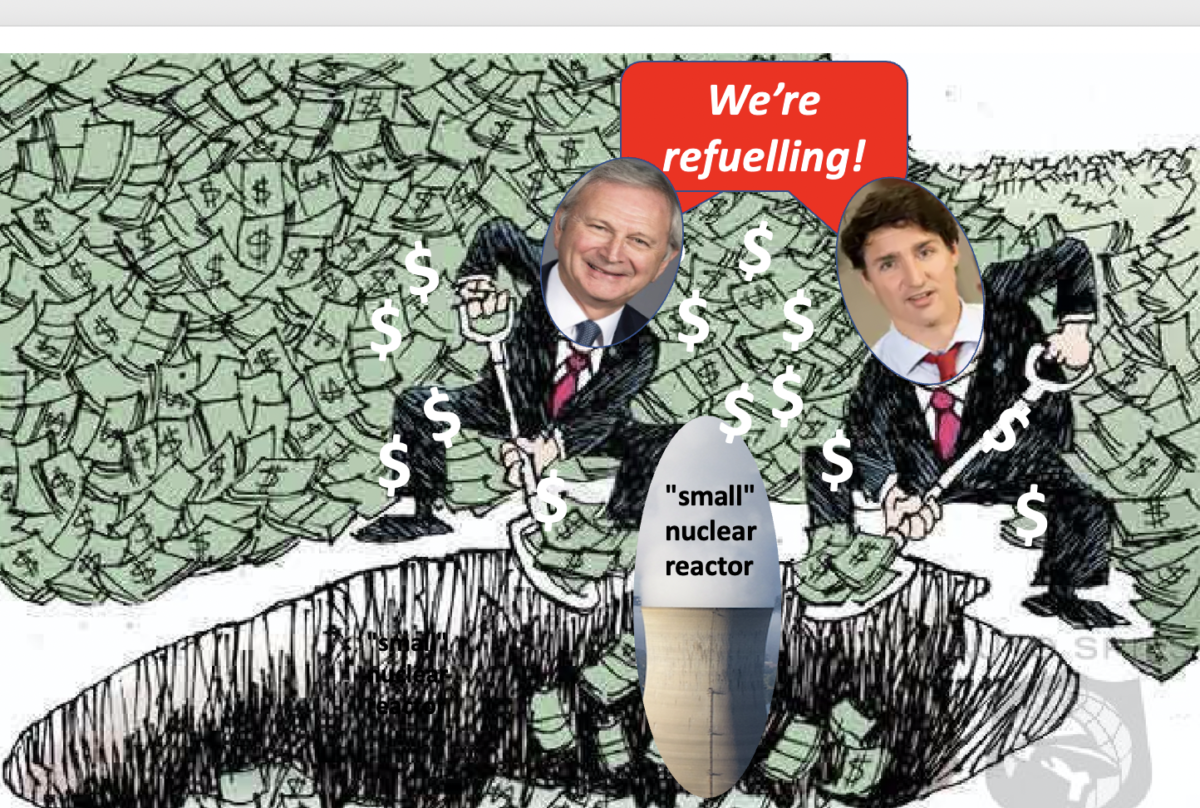
All these potential problems make the path forward for Moltex long and hard—and very expensive. The NuScale experience suggests that developing an SMR design to the point of securing a licence to build it could cost up to ten times what Moltex is asking for. Caving to Moltex’s demand now means falling deeper into a very deep money pit.

The graveyard of nuclear history is littered with numerous reactor designs that were never constructed because they would not have worked. Throwing more money at Moltex will not guarantee success. Wouldn’t it be best to stop now?

Susan O’Donnell is Adjunct Research Professor in the Environment & Society program at St. Thomas University, a social scientist with expertise in technology adoption, and an activist and core member of the Coalition for Responsible Energy Development in New Brunswick. M.V. Ramana is the Simons Chair in Disarmament, Global and Human Security and Professor at the School of Public Policy and Global Affairs, at the University of British Columbia in Vancouver.

This article was published by the NB Media Co-op on March 2, 2023, HERE, after earlier publication on February 28, 2023 by the National Observer, HERE.

Court grants public interest standing to environmental groups in case related to Goldboro LNG

We’re celebrating with CRED-NB core member, New Brunswick Anti-Shale Gas Alliance (NBASGA) after a Nova Scotia Court of Appeal ruling marked a major victory for access to environmental justice in Nova Scotia.

From the media release, here’s a quote from NBASGA’s Jim Emberger: “It would seem that issues of greenhouse gas emissions and climate change, and concerns about toxic mining pollution would, by definition, be ‘serious’, and that the public would naturally be entitled to reasons when governments decide to ignore those issues. It is too bad that it took a Court of Appeal to acknowledge these self-evident principles, but we are pleased that they did, and that we are now able to address the substance of these issues in court.”

Click HERE for the full story in the release.